RECIPES AND MORE FROM AN URBAN KITCHEN
Showing posts with label meat. Show all posts

Tuesday, April 10, 2012

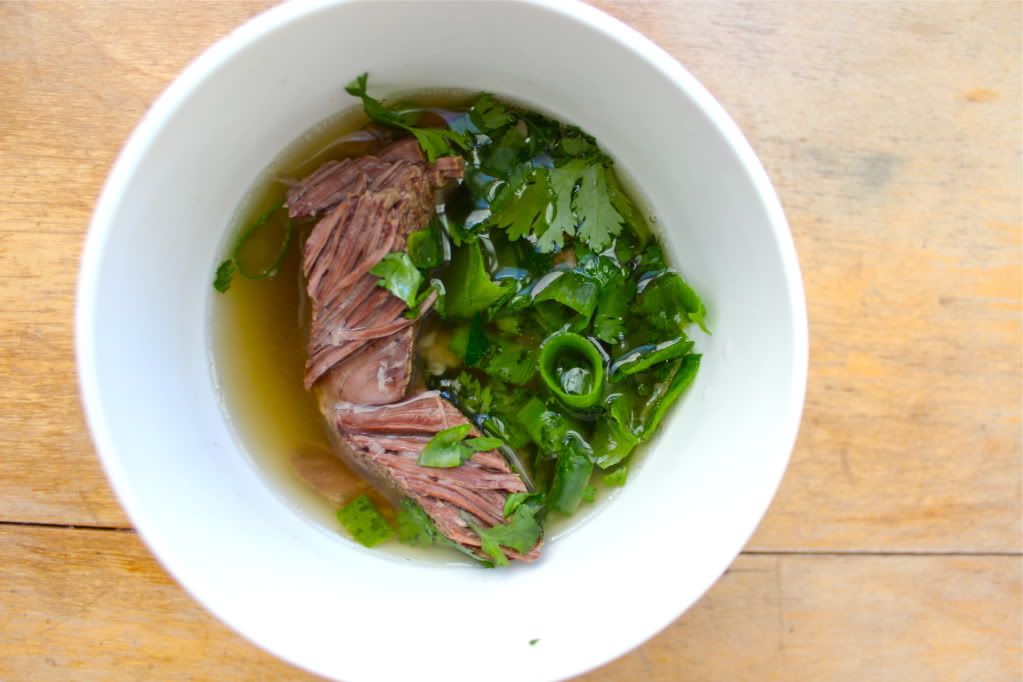
Brothy Beef Short Ribs


Over the weekend, I decided that I wanted to cook something soothing and restorative, something hot and cleansing. I wanted whatever I ingested to be the equivalent of a "chicken soup for the soul," but without the boring "chicken soup" part. Also, I didn't particularly feel like putting any effort into it. Sounds like a tall order, I know, but as usual my little collection of cloth-bound Canal House Cooking books provided the answer in just a few page flips.

This brothy short ribs recipe is one that I had looked at before, longingly, but for some reason, had never gotten around to making. My mistake. It requires six simple ingredients and a long afternoon of boiling time and that's about it. The chopping doesn't even come in til the very end, when you'll take all of 20 seconds to haphazardly cut up some scallions and cilantro to toss into your broth before devouring it whole. And while your big soup pot is on the stove transforming the short ribs into meltingly tender, falling-apart pieces of heaven, and the healthful ginger is turning water into something resembling a golden, seductive aphrodisiac, your apartment will fill with the most comforting, delicious smells known to man. Not an exaggeration. So take a day this weekend to try this out. It's a beautiful dish, clarifying and simple. xo

Brothy Beef Short Ribs
Adapted from Canal House Cooking, Volume No. 6, by Christopher Hirsheimer and Melissa Hamilton
Serves 4
Ingredients:
3-4 pounds beef short ribs
1 hand-size piece fresh ginger, unpeeled, halved crosswise
4 cloves garlic
Salt
1 bunch fresh cilantro, chopped
2-3 scallions, chopped

Directions:
Put the short ribs, ginger, and garlic into a large, heavy pot and add enough cold water (about 12 cups) to cover the meat by a couple of inches. Bring to a boil over medium-high heat, skimming any foam that rises to the surface. Reduce the heat to low and simmer very gently until the meat is tender, about 5 hours.

Remove and discard the ginger and garlic and any loose bones. Skim as much of the visible oil from the surface of the broth as you can. This may take a good 10 minutes of skimming. Be patient! You'll be rewarded with a beautiful, clear broth. Trim any fat and gristle from the meat and return to broth. Season the broth with salt. Serve the meat and broth in deep soup bowls, garnished with lots of cilantro and scallions. Pass salt around the table for seasoning the beef.

Monday, March 12, 2012

Old-Fashioned Beef Stew


I can't quite believe that this is the first real beef stew recipe I'm posting here. Beef stew is one of my all-time favorite childhood dishes, it's what I turn to when I'm in need of some serious comfort, it's the first thing I think of when I think of Julia Child (boeuf bourguignon, anyone?). Beef stew is just my thing. I make it as frequently as a food blogger's rotation will allow, and it always, always pops into my head when I'm thinking about what to make for dinner. Maybe I haven't written about it because it's so darn hard to photograph. The falling apart pieces of chuck roast, the creamy potatoes, sweet carrots, and luscious stock--it's all so delicious. And so....brown. A.K.A. incredibly difficult to take a good picture of. Brown foods are not a food photographer's friend. Just fyi. However, give a girl the right circumstances--time of day, light, stew recipe--and she'll give you a halfway decent picture. That's what happened this morning.

Anticipating the official end of freezing winter days, I fixed up a pot of old-fashioned beef stew on Sunday, dreaming of all the reheated bowls of the stuff I could enjoy over the week (everyone knows that stew gets better with a couple of days in the fridge, right?). As soon as I lifted the heavy, cast-iron pot out of the oven, apartment filling with good smells, I whipped out my trusty little camera and snapped. And snapped. And snapped. No dice. There was something about the light at 2:30 PM yesterday that made for shiny-looking stew. And shiny-looking stew does not look appetizing. Trust me. And so I decided to call it a night. I fixed my boyfriend and I heaping plates full of stew, poured some glasses of red wine, and we settled in with our rented movie of the night, Hugo (which, incidentally, was awesome). This morning, however, it was a whole different ballgame. The 8 AM morning light was perfect for making stew look just as good as it does in real life (hence, the photo you see above). And all was well in the world. I did, however, end up eating stew for breakfast. The perils of food blogging. xo

Old-Fashioned Beef Stew
Serves about 6
Ingredients:
1 (3-lb) boneless beef chuck-eye roast, cut into 2-inch pieces
Salt and pepper
3 tablespoons extra-virgin olive oil
2 onions, chopped coarsely
3 garlic cloves, minced
3 tablespoons all-purpose flour
1 cup full-bodied red wine
2 cups low-sodium chicken broth
2 bay leaves
1 teaspoon dried thyme
1 pound small red potatoes, peeled and halved
4 large carrots, peeled and sliced 1/4-inch thick
1/4 cup fresh parsley, chopped

Directions:
Heat oven to 300 degrees. Season beef with 2 teaspoons salt and 1 teaspoon pepper; toss to coat. Heat 2 tablespoons oil over medium-high heat in Dutch oven or cast-iron pot. Brown meat on all sides in 2 batches, about 5 minutes per batch, adding remaining 1 tablespoon oil if necessary. Remove meat and set aside. Add onions to now-empty pot and cook until almost softened, 4 to 5 minutes. Reduce heat to medium and add garlic; cook until fragrant, about 30 seconds. Stir in flour; cook until lightly colored, 1 to 2 minutes. Add wine, scraping up browned bits of bottom of pot. Add broth, bay leaves, and thyme and bring to simmer. Add meat and return to simmer. Cover and place in oven and simmer 1 hour.

Remove pot from oven, add potatoes and carrots, cover, and return to oven. Simmer until meat is just tender, about 1 hour. Remove stew from oven. (At this point, stew can be cooled to room temperature , then refrigerated for up to 3 days. Bring to simmer, then remove from heat before proceeding).

Stir in parsley, season with salt and pepper to taste, and serve. (Stew can be refrigerated for up to 3 days.)

Monday, December 26, 2011

Dry-Aged Rib Eye Steak with Parsley Butter


Ever since I can remember, Christmas Day meant treating ourselves to the absolute best steaks on the butcher block. I'm not a frequent red meat eater, but a few times a year, I go through intense cravings when all I want is to bite into a perfectly medium-rare, slightly bloody steak, cooked in lots of coarse salt and butter. Christmas Day, via tradition, is always one of those times. This year, due to a lack of qualified babysitters for Suz Monster and a sudden onslaught of new business for CA Creative, I stayed in NYC instead of making the 3,000 mile journey home to Hawaii (I'll be spending a couple of weeks there in January to make it up to my mother). However, there was no way I was going to let this slight inconvenience disrupt an ages-old food tradition. I simply took myself to Whole Foods, picked up a beautiful 2 lb bone-in, dry-aged rib eye, and stuck it in the fridge to wait it's turn in my trusty cast iron pan.

When the time came, I laid it on the counter in all it's well-marbled glory and let it come to room temperature while the oven heated. The tricks to a good steak are lots of good salt, careful browning, a few minutes in a hot oven, followed by a low-heat butter bath. I learned this method of steak-making from David Chang's Momofuku cookbook, and it unfailingly produces the absolute best steaks I've tasted, save for maybe the Porterhouse at Peter Luger's. And it even gives that legend some competition. This year, I decided to fancy things up a bit more and add a tasty little mix of parsley butter I whipped up quickly to serve on the side (that counts as a green, right?). After all, tradition can always be improved on.

Hope everyone had a fantastic holiday. Recipe down below. xo


Pan-Roasted Dry-Aged Rib Eye Steak with Parsley Butter
Ingredients:
For the steak:
One 2- to 2 1/2 lb bone-in rib-eye steak, preferably dry-aged
Kosher salt and freshly ground black pepper
4 tablespoons unsalted butter
A few sprigs of thyme
3 garlic cloves
2 small shallots
Maldon salt 

For the parsley butter:
8 tablespoons softened butter, preferably salted Irish like Kerrygold
1-2 cloves garlic, minced
1 small shallot, minced
Half a bunch of parsley, leaves chopped
Salt and pepper

Directions:
Heat the oven to 400 degrees. Heat a 10- to 12-inch cast-iron pan over high heat. While the pan is heating, season the steak liberally with salt--like you'd salt a sidewalk in New York in the winter--and then with pepper.

When the pan is good and hot--the steak should sizzle aggressively when it touches the pan--brown the steak. Put the steak in the pan and don't touch it or press it. After 2 minutes, take a peek: the steak should release easily from the pan and the seared side should be on the golden side of browned. Flip it. Sear the second side for another 2 minutes. Sear the steak up with the fatty side opposite the bone against the pan for 30 seconds, then turn the steak back over so the side that was seared first is against the pan. Put the steak in the oven and leave it untouched for 8 minutes.

Return the pan to the stovetop over low heat. Add the butter, thyme, garlic, and shallots to the pan. As soon as the butter melts, start basting: Use one hand to tilt the pan up at a 45-degree angle and, with the other hand, use a very large spoon to scoop up butter from the pool in the pan and spoon it over the steak. Repeat this motion constantly, cloaking the steak in an eddy of aromatic melted butter. After about 2 minutes of basting, give the steak a poke--it should be squishy soft, or somewhere close to that. If it's there, and if you like your steak rare, pull the steak from the pan and put it on a plate to rest. If you like your steak medium-rare, baste it for another minute or two. Do not cook this steak beyond medium-rare. It'll ruin it. And save the pan juice for the table! It's delicious.

Let the steak rest for at least 10 minutes. After 10 minutes, cut the steak off the bone, then slice it against the grain (cutting in the direction that was perpendicular to the bone) into 1/2-inch-thick slabs. Put on plates and pour any juices from where it rested and the cutting board into the pan drippings. Scatter the steak with Maldon salt.

While the steak is resting, make your parsley butter. Beat the butter in a bowl with a wooden spoon to make it smooth and a bit creamy. Add the garlic, shallots, and parsley, and season with salt and pepper. Stir until well-combined. The butter can be used right away or covered and refrigerated for up to 3 days. Serve alongside the steak.

Monday, November 14, 2011

Fasoolya Khadra (Beef and Green Bean Stew)


When I was growing up, one of my favorite mom-made meals was beef stew. I loved the tender chunks of beef, the rich tomato broth, the rough squares of potatoes, and the fact that the whole thing was spooned, steaming, over rice. It was the heartiest, most comforting dinner on her rotation and every time she served it, I would hungrily spoon up every single bite, always, always going for seconds.

I haven't managed to find a recipe quite like my mother's yet (which means I'll be spending some time over the holidays plying her for a cooking lesson), but it's not for lack of trying. I make just about every feasible beef stew recipe that I come across--and by feasible, I mean "easy for home cooks to make," as every stew recipe should be, in my opinion. Inevitably, I've found some very, very good ones. This version, from the Food52 Cookbook, comes from Jordan and is filled with exotic spices that will fill your kitchen with the most amazing smells. By the end of the stewing time, the beef is fork-tender, and the green beans practically melt in your mouth. And just like my mom's, it's served spooned over a bed of fluffy white rice. Perfect (for now). xo

Fasoolya Khadra (Beef and Green Bean Stew)
Adapted from The Food52 Cookbook, by Amanda Hesser and Merrill Stubbs
Ingredients:
1 lb stewing beef, cut into 1-inch chunks
Salt and freshly ground black pepper
1 lb green beans
1 15-oz can whole peeled tomatoes
2 garlic cloves, minced
2 teaspoons ground coriander
2 teaspoons ground cumin
White rice, for serving

Directions:
Season the beef generously with salt and pepper, place in a skillet large enough to hold the beef in one layer, and add enough water to just cover the beef. Cover and simmer gently over medium-low heat for about 10 minutes until the meat is no longer pink.

Remove the ends from the green beans. Cut them into 1 1/2 inch pieces.

Remove 1 cup of the simmering liquid and reserve. Add the green beans to the skillet and simmer for 5 minutes.

Coarsely cut up tomatoes in can with kitchen shears, then put them into a large bowl (with juice). Add the reserved beef broth and minced garlic and thoroughly combine. Add this mixture to the green beans and beef. Season generously with salt and pepper, then stir in the coriander and cumin. Cover and simmer gently until the meat is fork-tender, 1 1/2 to 2 hours. (Add more water if the pan gets dry--there should be half an inch of sauce at all times.) For the most delicious flavor, let the stew sit on the stove for a while after cooking and reheat later.

Thursday, October 20, 2011

Sausages with Apples and Onions


This is one of my absolute favorite quick, one-skillet meals that I start craving every time it gets a bit chilly out. The tiny, sweet apples that crop up at the farmers' market in October just beg to be fried with some meaty, flavorful sausages to balance them out. To me, this dish is the epitome of comfort food, and it's so quick that I actually made it for breakfast not once, but twice this week. In case that means nothing to you, my mornings are usually a frenzied whirlwind of trying to get to the gym, feed Suz Monster, shower, wash my hair, answer urgent emails on my Blackberry whilst simultaneously brushing my teeth, etc. In other words, if I have time to make a recipe on a workweek morning, trust me, it's ridiculously fast and easy. And in this case, it's also more than substantial enough to eat for dinner, if you're so inclined. I love a recipe that multitasks, don't you? Recipe below serves four, but feel free to cut it in half and save some for leftovers if you're only cooking for one. xo

Sausages with Apples and Onions
From the Canal House Cookbook, Volume 5
Ingredients:
2 tablespoons olive oil
4 small yellow onions, halved lengthwise
8 fresh sausages, pricked (use your fave!)
4 small apples, peeled, cored, and quartered
Salt and pepper
Fresh sage, optional

Directions:

Heat the oil in a large heavy skillet over medium heat. Add the onions cut side down, cover, and cook until just tender and browned on the bottom, about 15 minutes.

Tuck the sausages and apples around the onions in the skillet. Season with salt and pepper. Use two skillets if everything is too crowded together. Cook over medium heat, turning the sausages and apples as they begin to brown, but leaving the onions in place. Take care to leave the onion halves whole. Continue cooking until everything is nicely browned, then reduce the heat to medium-low.

Cover the skillet and cook until the sausages are cooked through and the apples and onions are tender, 5–10 minutes. Adjust seasonings. Serve garnished with fresh sage, if you like.